Reviewed · FULL-DAY
Private Full Day Ephesus Tour from Bodrum
Ephesus is the main event here: a vast Roman city where you walk marble streets past the Library of Celsus, the Great Theatre, temples, public squares, and private homes. The private format lets your guide adjust the pace, which matters when the Turkish sun is strong or an older family member needs extra help.
I like the comfortable Mercedes Vito and the chance to travel with your own group rather than follow a large bus. I also like the guide-led context, especially when guides such as Melahat, Selim, Bano, Nur, and Ulas are available. The catch is the long road from Bodrum, plus entrance fees and possible shopping stops that can eat into your day.
In This Review
- Key points to know before booking
- The real appeal: an ancient city on a private schedule
- Meryemana, a quiet mountain shrine
- Ephesus: walking through the Roman city
- The Odeion and the politics of public life
- Temples, gates, and Curetes Street
- Terrace Houses: the private side of Ephesus
- The Library of Celsus and the Great Theatre
- St. John’s Basilica and the Temple of Artemis
- Lunch, shopping, and the parts to clarify
- Is $259 a fair price?
- Who will get the most from this tour?
- Final call: book it for access, not speed
- FAQ
- How long is the private Ephesus tour from Bodrum?
- How far is Bodrum from Ephesus by car?
- Is hotel pickup included?
- Where do cruise passengers meet the guide?
- Is airport pickup available?
- Are Ephesus entrance tickets included?
- Is the House of the Virgin Mary entrance fee included?
- Is lunch included?
- Can I cancel for a full refund?
Key points to know before booking
- The drive takes time: Bodrum to Ephesus is advertised at about two hours each way, but traffic and conditions can make it longer.
- Your own vehicle and guide: The tour uses a private, air-conditioned Mercedes Vito with hotel, airport, or cruise-port pickup.
- Ephesus tickets cost extra: The ancient city entrance is listed at €40 per person, and the House of Virgin Mary costs €18.
- The itinerary is packed: You visit major monuments, the Terrace Houses, St. John’s Basilica, and the Temple of Artemis in roughly six to eight hours.
- The House of Virgin Mary is optional in spirit, not always in practice: It is meaningful for religious pilgrims, but you should state clearly if you prefer more time at Ephesus.
- Cruise timing needs care: You must provide ship and boarding details, and a late return drive can make this a risky choice for a tight port schedule.
The real appeal: an ancient city on a private schedule
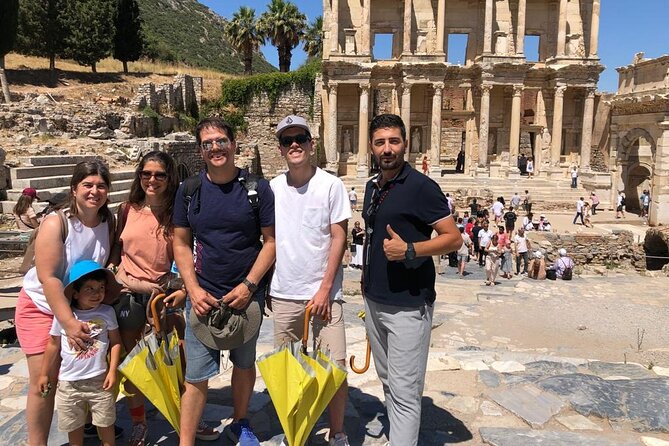
This is not a quick shore excursion that drops you at one monument and sends you back to the ship. It aims to give you a full day in the Ephesus area, combining Roman ruins, early Christian sites, and a stop at one of the ancient world’s Seven Wonders.
The private setup is the strongest feature. You ride with only your own party, and the guide can explain details, answer questions, and adjust the walking pace. That is useful at Ephesus, where the most important sights are spread along sloping streets and exposed stone paving.
The van is a practical choice for this route. Air conditioning is not a luxury in western Turkey during warm months, and the Mercedes Vito provides a comfortable place to cool down between stops. Pickup is offered from Bodrum hotels, Bodrum Airport, and the cruise port.
The tradeoff is distance. Ephesus lies far enough from Bodrum that the road journey can consume four to six hours of the day. The advertised drive is two hours, but actual timing can reach two hours and 25 minutes or, under less favorable conditions, closer to three hours. If your cruise ship has a firm reboarding deadline, treat the return trip as the main planning issue.
A few more Kusadasi tours worth comparing
- From Kusadasi: Full-Day National Park Jeep Tour with Lunch
★ 4.4 · 581 reviews - Full-day Pamukkale and Hierapolis Tour from Selcuk or Kusadasi
★ 5.0 · 209 reviews - PRIVATE Ephesus Full Day Tour from Izmir
★ 5.0 · 98 reviews
Meryemana, a quiet mountain shrine
The first stop is Meryemana, also called the House of the Virgin Mary. It sits on Bulbul Mountain, about nine kilometers from Ephesus, in a wooded setting away from the traffic and crowds around the main ruins.
The site is linked by tradition to Mary’s final years. According to the account associated with the shrine, she came to the area with Saint John, who spent years spreading Christianity around Ephesus. The small stone structure combines a traditional home with later Christian and Muslim devotional elements.
You can expect about 45 minutes here. The house itself is compact, with an anteroom, bedroom, prayer area, and a room with a fireplace. Candles are available, and a nearby spring and prayer wall form part of the devotional experience.
For a pilgrim, this may be the emotional center of the day. For a visitor focused on archaeology, it may feel less essential than Ephesus itself. The entrance fee is not included, and the listed cost is €18 per person. Tell your guide early if you want to skip this stop or spend that time at the ancient city. Some people have felt pushed toward religious and commercial stops when they wanted a more focused archaeological visit.
Ephesus: walking through the Roman city
Ephesus deserves the largest share of your attention. The ancient city was shaped by Greek, Roman, and later Christian periods, and its surviving streets and buildings make it easier to picture daily life than at many archaeological sites.
The main Ephesus entrance fee is listed as €40 per person and is not included in the tour price. The walk includes uneven stone surfaces, slopes, and exposed areas, so moderate physical fitness is required. Wear sturdy shoes, carry water, and expect limited shade.
The State Agora comes early in the sequence. Unlike a commercial marketplace, this square served civic and political purposes. Government business and public meetings took place here. Excavations also found older graves, an archaic terracotta sarcophagus, and a water reservoir tied to the Pollio Aqueduct.
It is a short stop of about 15 minutes, but it helps explain that Ephesus was not only a place of temples and shops. It was a functioning city with government, water systems, burial areas, and public administration.
The Odeion and the politics of public life
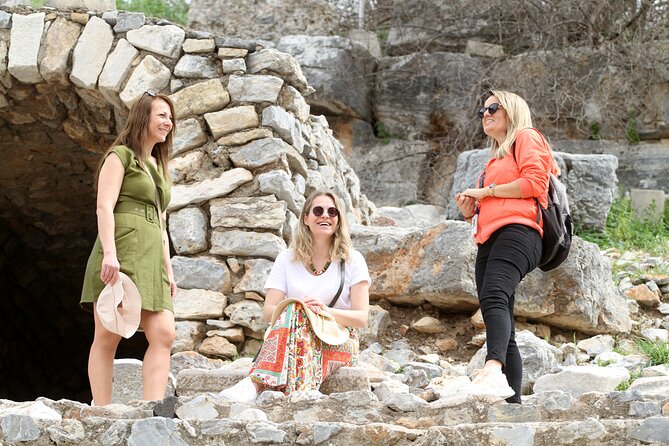
The Odeion is a small theater with seating, an orchestra, and a stage building. It held roughly 1,500 people and served two purposes: it was a meeting place for the city council and a performance hall.
Your guide can use this stop to explain how Ephesus was governed. The larger Great Theatre hosted public assemblies, while the smaller Odeion served the Bouleia, a more limited council. That contrast gives the ruins a human scale. You are not simply looking at decorative stone. You are looking at the places where decisions were made and performances were staged.
The stop lasts about 15 minutes. The seating and stage have been partly restored, and the original roof is gone. Do not expect a complete theater, but the shape remains easy to read.
A different sort of day out of Kusadasi:
- FOR CRUISERS: Skip The Lines PRIVATE EPHESUS TOUR &On Time Return
★ 5.0 · 8,527 reviews - Top Choice For Cruisers: Ephesus, Mary’s House WITH TICKETS+LUNCH
★ 5.0 · 7,233 reviews - PRIVATE EPHESUS TOUR FOR CRUISERS: On-time Return and Skip-Line
★ 5.0 · 5,807 reviews - PRIVATE NO HIDDEN FEES Ephesus, Mary’s House Guided Tour /GRP OPT
★ 5.0 · 2,455 reviews
Temples, gates, and Curetes Street
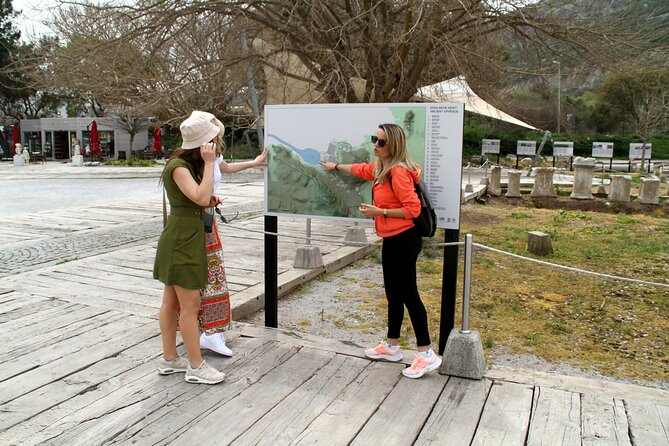
The Temple of Domitian occupies a large raised terrace and is important because it was the first known Ephesus structure dedicated to a Roman emperor. The temple represented the city’s special status as a neokoros, a city permitted to maintain an imperial cult center.
The Temple of Hadrian is one of the most attractive surviving facades along Curetes Street. Its Corinthian columns and curved arch are better preserved than many surrounding structures. The temple was dedicated to Emperor Hadrian after his visit to Ephesus in the second century.
At Hercules Gate, only the two sides of the gateway remain. Reliefs of Hercules date to the second century, although the gate was moved into its current position in the fourth century. Its narrow opening also tells you something about urban change: by that period, Curetes Street had become largely pedestrian rather than open to wheeled traffic.
Each of these stops is scheduled for about 15 minutes. That is enough for a clear explanation and photographs, but not enough for a long lecture. If you enjoy architectural details, ask your guide to slow down at the Temple of Hadrian and Hercules Gate.
Terrace Houses: the private side of Ephesus
The Terrace Houses are one of the most worthwhile additions to a standard Ephesus visit. They sit opposite the Temple of Hadrian and reveal how prosperous Roman families lived.
Six residential units were built across three terraces on the lower slope of Bulbul Mountain. The oldest structures date to the first century BC, and the houses continued in use until the seventh century AD. Their floor mosaics, wall frescos, rooms, and courtyards show a side of Ephesus that grand monuments cannot provide.
Protective roofing covers the excavation, which makes this stop more comfortable in harsh weather. Two houses are open as a museum, with mosaics and frescos stabilized for display.
You have about 30 minutes here. The added entrance arrangements should be clarified before the day begins because the main Ephesus ticket is separate from the tour price, and the supplied cost details do not clearly list a separate Terrace Houses fee. If you want to see domestic architecture rather than only famous facades, this is where the private tour earns its keep.
The Library of Celsus and the Great Theatre
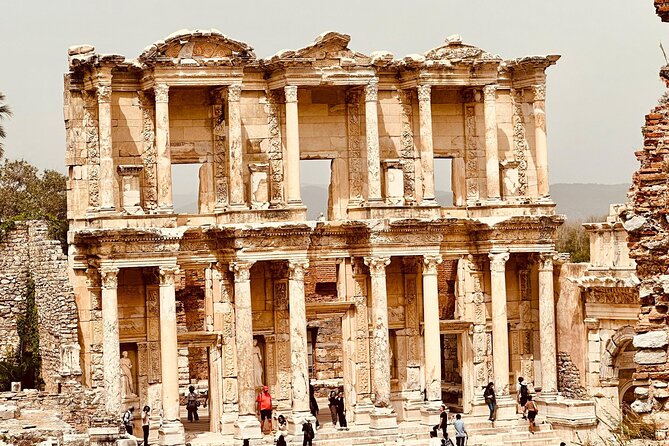
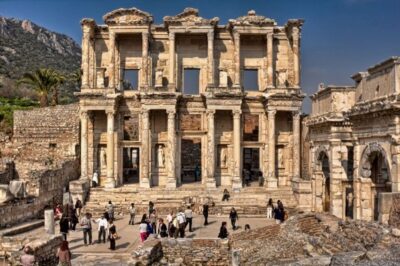
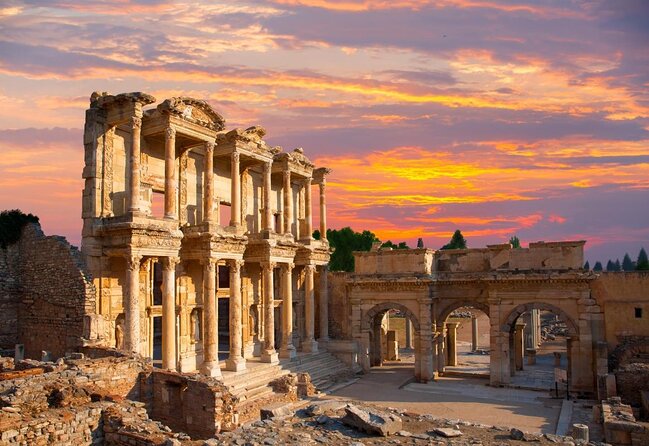
The Library of Celsus is the image most people carry home from Ephesus. Built in AD 117, it was both a library and a monumental tomb for Gaius Julius Celsus Polemaeanus, governor of the province of Asia. His burial chamber was beneath the ground floor.
The library held more than 12,000 scrolls, stored in wall niches. Double walls helped protect the manuscripts from temperature and moisture changes. Statues represented wisdom, knowledge, intelligence, and virtue, although the originals are no longer all in place.
The scheduled stop is 15 minutes, which sounds brief for such a famous building. In practice, you will likely see it from the street, hear the main explanation, and take photographs. Ask your guide about the tomb and the double-wall design, two details that are easy to miss when you are concentrating on the ornate facade.
The Great Theatre is larger and more dramatic. It was first built in the Hellenistic period and later expanded by the Romans. With a capacity of about 25,000, it is described as the largest theater in Anatolia.
The cavea has 66 rows divided into three horizontal sections. The theater hosted plays and concerts, but it also served religious, political, and philosophical purposes. Gladiator and animal contests took place here as well. The setting helps explain why this was the city’s main public gathering place.
The scheduled visit is again about 15 minutes. That is enough to stand in the orchestra area and look across the seats, but you may want to request a little more time if the group is especially interested in Roman public life.
St. John’s Basilica and the Temple of Artemis
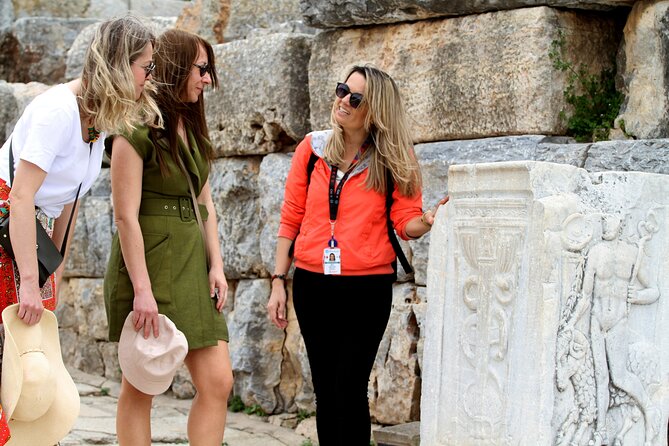
St. John’s Basilica sits on the southern slope of Ayosolug Hill near Selcuk. Tradition holds that Saint John spent his last years around Ephesus and was buried here. A small chapel was built over the grave in the fourth century, then expanded into a large basilica under Emperor Justinian in the sixth century.
The ruins are important for understanding Ephesus as a Christian center, not just a Greek and Roman city. Saint John is traditionally associated with the Gospel of John and with the early Christian community in the area. The basilica stop takes about 30 minutes.
The final stop, the Temple of Artemis, is short but historically important. Artemis was a fertility goddess, and her enormous temple was one of the Seven Wonders of the ancient world. Today, only foundations and scattered column fragments remain because the site was damaged, reused, and affected by the marshy ground that formed there over time.
You get about 25 minutes and no admission charge. The stop can feel underwhelming if you expect a standing temple, but it is worth seeing because the scale of what once existed is part of the story. The most complete surviving pieces are now in the British Museum, not at the site.
Lunch, shopping, and the parts to clarify
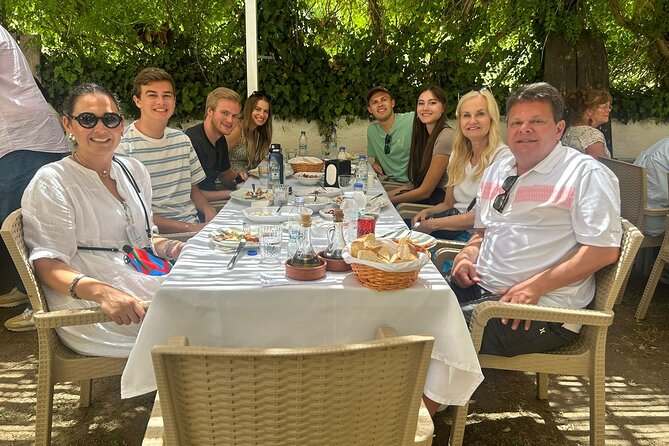
Lunch is not included. The listed price is about $15 per person, and the day includes a local meal stop. The food has been praised as plentiful and tasty, but the exact restaurant can vary. Ask what is included before ordering extras.
Commercial stops may also appear, including a carpet workshop, leather showroom, ceramic shop, Turkish coffee or candy stop. These can add a useful look at Turkish craft traditions. A carpet demonstration, for example, can show how rugs are woven and priced.
The problem is pressure. If you do not want to shop, say so clearly at the start. One serious complaint involved a rug purchase that had not arrived months later, so keep receipts, delivery terms, and contact details if you buy anything. A private tour should give you flexibility, not make you feel obliged to spend more.
Before departure, ask the operator four direct questions:
- How many shopping stops are planned?
- Can they be skipped?
- How much time will be reserved for Ephesus?
- Are all extra entrance fees clear?
Those answers will tell you more about the day than the attractive list of monuments.
Is $259 a fair price?
The advertised cost is $259 per person. That is not cheap, especially once you add the €40 Ephesus entrance, €18 House of Virgin Mary ticket, and roughly $15 lunch. For two people, the base tour alone comes to $518 before extras.
Still, price comparisons need context. You are paying for private transport, hotel or port pickup and return, an English-speaking licensed guide, parking, taxes, and a vehicle reserved for your group. A private van is especially useful for families, older relatives, and anyone who wants to avoid a large coach.
The value drops if your ship schedule allows only a rushed visit. In that case, you may pay mainly for the long transfer and have little time for the sights. The value improves if you can use the full six to eight hours and want a personal guide rather than a shared excursion.
The separate ticket charges are the least transparent part of the pricing. Since the Temple of Domitian is shown with admission included while the overall Ephesus ticket is listed as extra, confirm exactly which fees you will pay on the day.
Who will get the most from this tour?
I would recommend it most strongly to a small family group, a couple with a firm wish list, or a private party that values door-to-door transport. It also suits people who want both Ephesus and the religious sites around Selcuk in one day.
A private guide can be a real help for families with children. Guides such as Eylem have been praised for keeping younger visitors engaged, while other guides, including Bano and Nur, have been described as warm, flexible, and strong on Greek, Roman, Byzantine, and Ottoman subjects. Guide assignments are not guaranteed, so treat those names as examples rather than a promise.
Older adults should be able to manage moderate walking, but Ephesus is not flat or fully shaded. One guide, Melahat, has been noted for helping an elderly family member, which shows the advantage of a private format, though you should still discuss mobility needs before booking.
I would be cautious if you are on a cruise with only a narrow margin before reboarding. You must provide the ship name, docking time, disembarkation time, and reboarding time, but that does not remove the risk of traffic. A return with only a few minutes to spare is not a comfortable way to end the day.
Final call: book it for access, not speed
Book this tour if Ephesus is a priority and you want a private vehicle, a personal English-speaking guide, and the freedom to shape the day. The Library of Celsus, Great Theatre, Terrace Houses, and House of the Virgin Mary make a strong mix of archaeology, religion, and local culture.
Think twice if you want a low-cost excursion, dislike shopping stops, or have a tight cruise schedule. The drive is the central weakness, and the extra tickets raise the true cost well above $259 per person.
If you book, request a clear timetable, confirm all entrance charges, ask to limit commercial stops, and protect plenty of time for Ephesus itself. Free cancellation is available up to 24 hours before the start time, which gives you some flexibility if your plans change.
FAQ
How long is the private Ephesus tour from Bodrum?
The tour is scheduled for approximately six to eight hours. The drive from Bodrum to Ephesus is advertised at about two hours, but traffic and weather can make the journey longer.
How far is Bodrum from Ephesus by car?
The tour information states that it takes about two hours to drive from Bodrum to Ephesus Ancient City. Actual timing can be longer, including about two hours and 25 minutes or up to three hours under some conditions.
Is hotel pickup included?
Yes. Pickup and drop-off are offered from Bodrum hotels. The meeting point is at the hotel reception.
Where do cruise passengers meet the guide?
Cruise passengers meet at the exit gate of the immigration terminal at Bodrum Cruise Port. The guide carries a board marked OTTI Travel.
Is airport pickup available?
Yes. Pickup is available from Bodrum Airport, also called BJV. The meeting point is at the exit gate of the domestic terminal, where the guide will hold an OTTI Travel sign.
Are Ephesus entrance tickets included?
No. The Ephesus Ancient City entrance fee is listed at €40 per person and is not included in the tour price.
Is the House of the Virgin Mary entrance fee included?
No. The admission fee is listed at €18 per person and must be paid separately.
Is lunch included?
No. A local lunch is available for about $15 per person, but it is not included in the tour price.
Can I cancel for a full refund?
Yes. You can cancel at least 24 hours before the experience start time for a full refund. Changes or cancellations made less than 24 hours in advance are not accepted for a refund.
Just added around Kusadasi
- Kusadasi: Private Ephesus Day Trip with Pickup and Drop-off★ 5.0 · 3 reviews
- Kusadasi: Quad Safari★ 4.3 · 3 reviews
- Shore Excursion: Private Pamukkale Tour From Kusadasi Port★ 5.0 · 3 reviews
- Ephesus Shore Excursions For Cruisers★ 5.0 · 3 reviews
- Ephesus and House of Virgin Mary From Kusadasi or Selcuk★ 4.0 · 3 reviews
- Best Of Private Ephesus Tour From kusadasi Cruise Port★ 5.0 · 3 reviews
- Ephesus & Mary’s House & Artemission Tour for Cruisers★ 5.0 · 3 reviews
- The Best of Ephesus Tour For Cruisers★ 4.0 · 3 reviews
Full-Day, compared.

Full-day Pamukkale and Hierapolis Tour from Selcuk or Kusadasi
Read our review →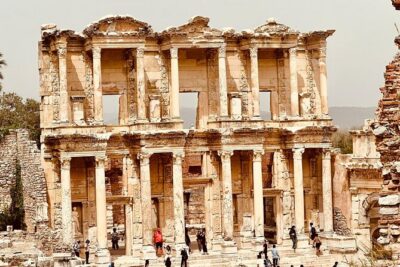
Pamukkale and Hierapolis Full-day Guided Tour from Kusadasi
Read our review →
Skip The Line: Full Day Explore Ephesus with Lunch
Read our review →