
Reviewed · PRIENE, MILETUS & DIDYMA TOURS
Priene, Miletus, and Didyma Day Tour from Kusadasi
Didyma’s huge Temple of Apollo is the star here, but the real pleasure is seeing it alongside Priene and Miletus, two quieter ancient sites that help explain how Ionian cities worked. You get grand columns, a Greek theater, old harbors, and wide views without spending the day at only one famous ruin.
I like the small minibus group, capped at 14 people, and I like having an art historian guide to connect the ruins to trade, philosophy, religion, and politics. Guides named Gul, Mehmet, and Melike have all received especially warm praise for making the day clear and enjoyable.
The main consideration is the pace. Three large archaeological areas in about eight hours means plenty of walking and a fair amount of time on the road. Also, the published information conflicts on entrance fees, so confirm exactly what is covered before paying.
In This Review
- Key points to know before booking
- Three Ionian cities in one long day
- Priene: a theater above the Maeander plain
- Miletus: where trade, science, and theater meet
- Didyma: an oracle beneath enormous columns
- What the small group changes
- Lunch, transport, and the real value of the price
- Who will enjoy this day most
- Practical details before you reserve
- Should you book Priene, Miletus, and Didyma?
- FAQ
- Where does the tour start?
- How long does the tour last?
- What language is the tour offered in?
- How many people can join the group?
- Is lunch included?
- Are entrance fees included?
Key points to know before booking
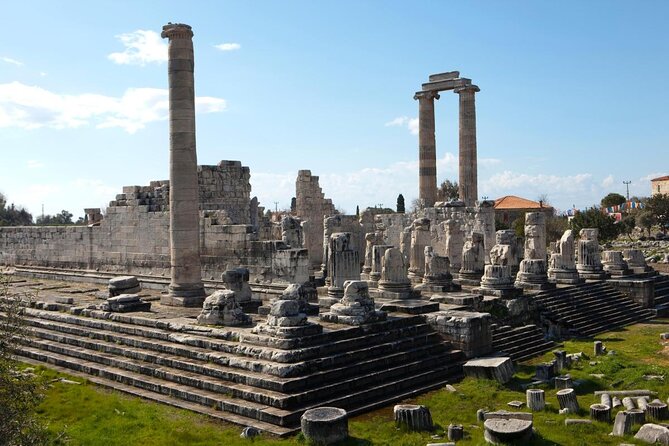
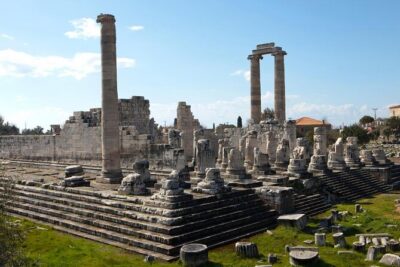
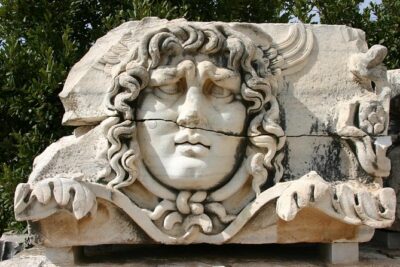
- Didyma’s Temple of Apollo is the grand finale: Look for the carved Medusa head, massive stepped base, and surviving rows of columns.
- Priene gives you the best setting: Ruins sit above the Maeander flood plain, with views toward cotton fields and the Aegean.
- Miletus connects ancient ideas with city life: See the theater, agoras, baths, harbor monuments, and remains of later Byzantine and Ottoman buildings.
- The group stays small: The minibus holds no more than 14 people, and one booking went ahead with only two participants.
- Lunch is included: The day includes a buffet meal, though drinks cost extra and a vegetarian option must be requested when booking.
- It works well after Ephesus: If you have already seen Ephesus, these less crowded ruins provide a useful and more varied follow-up.
Three Ionian cities in one long day
This is a strong choice if you want more than the standard Ephesus visit from Kusadasi. Priene, Miletus, and Didyma are not interchangeable ruins. Each shows a different side of the ancient Greek world: urban planning at Priene, commercial and intellectual power at Miletus, and religious authority at Didyma.
Pickup begins around 9:00 a.m. from hotels or the port in Kusadasi, with pickup also offered in the Selcuk area. You ride between sites in a minibus rather than arranging several separate taxis or buses. That matters here because the sites are spread out, and public transport would make the day much harder to manage.
The tour lasts about eight hours. That gives you a full day, but not a slow archaeological study. I would choose it for a broad, well-guided look at the region rather than for long stretches of quiet exploration at every ruin.
An English-speaking art historian leads the visits. Gul is praised for supplying a great deal of useful information, while Mehmet is described as personable and well informed. Melike is also singled out for making the day pleasant and explaining the sites well. Guide quality can vary on any departure, but the named guides give you a useful sense of the level of interpretation to expect.
More Priene, Miletus and Didyma trips:
- Ephesus, Priene, Miletos and Didyma Tour
★ 4.9 · 21 reviews - Priene Miletos Didyma Tour From Kusadasi / Selcuk Hotels
★ 5.0 · 15 reviews - NO HIDDEN FEES : Private Ephesus – Miletus – Didyma
★ 5.0 · 13 reviews
Priene: a theater above the Maeander plain
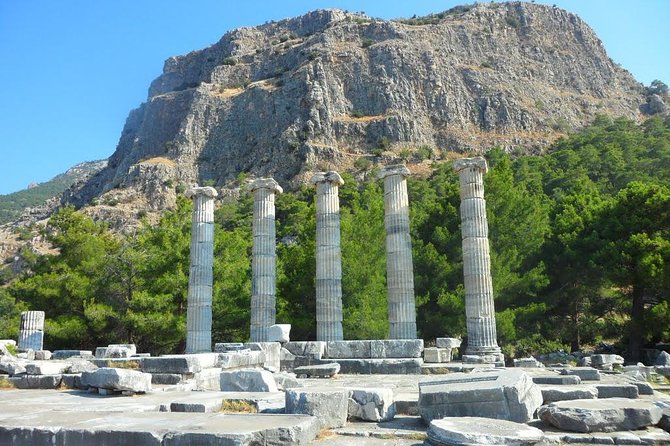
Priene is the most atmospheric stop. The ancient city sits between Samsun Mountain and the broad flood plain of the Maeander River. From the ruins, you look over cotton plantations stretching toward the Aegean, with the site’s stone remains set against the mountain rather than swallowed by a modern town.
The city belonged to the Ionian world and was one of twelve linked cities in the Ionian League. Its position also changed over time as the Maeander altered the coast. What was once a port city is now well inland, a reminder that rivers can redraw an entire region.
The Temple of Athena is the chief building on the hill. The theater is another highlight, especially its front row with five carved seats for important officials. The theater held about 6,500 people and was built in the Hellenistic period. Its acoustics are still noted as a special feature, and the fact that it was not rebuilt by the Romans gives it an unusually clear Greek character.
Priene also offers a glimpse of ordinary comfort. The city was once prosperous, and many houses had private bathrooms with toilets. The figure given for private facilities is about one-third of the population, a striking detail that helps turn a pile of stones into a real residential community.
Allow about an hour here according to the planned schedule. That is enough to see the key monuments and take in the view, but you will not have time to wander every street at leisure. The hilltop setting may also be a factor if walking on uneven ground is difficult.
There is a fee inconsistency worth noting. The main tour description says all entrance fees are included, but the Priene details say admission is not included, and the general inclusions section also conflicts with the exclusions section. Ask Apasas Travel to clarify this before departure.
Miletus: where trade, science, and theater meet
Miletus was once a major port on the Maeander River. From here, ships reached the Mediterranean, Black Sea, and Sea of Marmara. The river later silted up, leaving the ancient city far from the coast, much as at Priene.
Before 500 BCE, Miletus was one of the strongest Greek cities in the eastern Aegean. Its position made it a natural outlet for goods moving from inland Anatolia. It was also a center of thought, producing figures such as Thales, Anaximander, Anaximenes, and Hecataeus.
That combination of commerce and ideas is what makes Miletus especially rewarding. You are not just looking at a theater or a broken colonnade. You are walking through a city that helped shape early Greek science, philosophy, writing, and political life.
The theater is the most obvious landmark. It is large, built into the hillside, and gives you a feel for the scale of public life in the city. The tour also includes the Byzantine fortress, harbor monuments, the Delphinium sanctuary, the South Agora, and the Baths of Faustina.
Later remains add another layer. The Mosque of Ilyas Bey and a caravansaray show that this was not only an ancient Greek and Roman site. The ruins reflect centuries of changing use, although the amount of attention given to each later building will depend on the guide and the day’s timing.
The planned visit is about three hours, making Miletus the longest archaeological stop. That is sensible because the site covers a lot of ground. Wear sturdy shoes, carry water, and save some energy for the final stop at Didyma.
Didyma: an oracle beneath enormous columns
Didyma provides the most dramatic architecture of the day. In the ancient world, it was famous for the oracle of Apollo, whose answers drew pilgrims from across the region. Didyma was not a normal city in its prime. It was a sacred center connected to Miletus by the Sacred Way.
The name is linked with the idea of twins, referring to Apollo and Artemis, the children of Zeus and Leto. The first Greek temple here was built in the late eighth century BCE, though the early structure now lies beneath later Hellenistic construction.
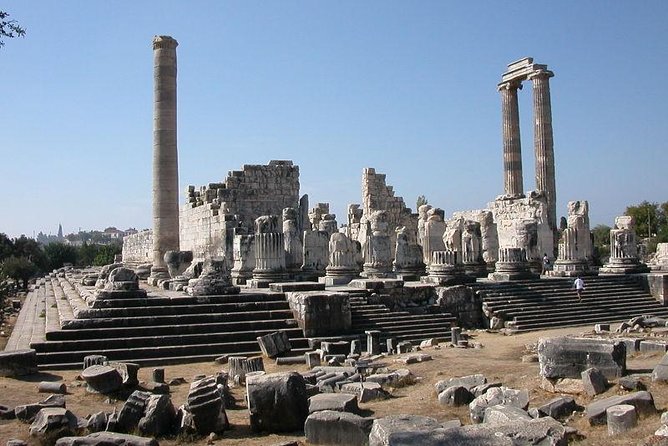
The Temple of Apollo was planned on a colossal scale. Even in ruin, its great stairway, broad base, and remaining columns give you a clear sense of its ambition. A carved Medusa head is another memorable detail. The stone face is not tucked away in a museum. It forms part of the open-air site, where you can study its weathered features at close range.
The oracle gives Didyma a different mood from Priene and Miletus. Priene feels like a city viewed from above. Miletus feels like a former center of public and commercial life. Didyma is about ritual, pilgrimage, and the power of a sacred place.
The schedule allows about three hours here, though the exact division of time may shift. That is generous enough to see the temple properly and hear the story behind the Sacred Way. Didyma is also the site most likely to satisfy you if you want a single unforgettable monument from the day.
A different sort of day out of Kusadasi:
- FOR CRUISERS: Skip The Lines PRIVATE EPHESUS TOUR &On Time Return
★ 5.0 · 8,527 reviews - Top Choice For Cruisers: Ephesus, Mary’s House WITH TICKETS+LUNCH
★ 5.0 · 7,233 reviews - PRIVATE EPHESUS TOUR FOR CRUISERS: On-time Return and Skip-Line
★ 5.0 · 5,807 reviews - PRIVATE NO HIDDEN FEES Ephesus, Mary’s House Guided Tour /GRP OPT
★ 5.0 · 2,455 reviews
What the small group changes
The minibus carries a maximum of 14 people. That is small enough for a guide to answer questions without shouting across a coach, and it makes hotel pickup less cumbersome than a large bus circuit.
One especially useful detail is that the tour has gone ahead with only two participants. A small booking can therefore produce a very personal day, although you should remember that the minimum number of participants still applies and a departure can be canceled if it is not met.
A small group does not remove every practical limitation. You still follow a fixed route, and the guide must keep the day moving. If you want to photograph every column or spend an hour sitting in the theater, this is not the right format.
For most people, the trade is worthwhile. You get transport between remote sites, a guide who can explain what you are seeing, and a better chance to ask about details such as the Ionian Confederation, early coins from Miletus, or the changing coastline.
Lunch, transport, and the real value of the price
The listed price is $216.74 per person. That is not a bargain-basement excursion, but it covers an unusually full day: hotel or port pickup, minibus transport, an English-speaking art historian, buffet lunch, and the three-site route.
The value depends heavily on the entrance-fee question. The headline information says all entrance fees are included, while another section says entrance fees are excluded and the Priene stop specifically says admission is not included. Since those statements cannot all be correct, get written confirmation of the final cost. A surprise fee can change the calculation, especially for a family.
Lunch is included, which saves time and avoids stopping at a separate restaurant search during a tightly planned day. Drinks are not included. A vegetarian meal is available if you request it at booking.
The pickup service is useful if you are staying in Kusadasi or Selcuk, and port pickup makes the tour possible for some cruise passengers. Confirm your exact pickup point when booking, particularly if you are arriving by ship or staying outside the main hotel areas.
Who will enjoy this day most
I would recommend this tour to you if you have already visited Ephesus and want a different side of western Turkey. Ephesus is larger and more polished as a major sight, while this route spreads the attention across three places with distinct stories.
It also suits anyone interested in ancient Greek culture beyond temples. Miletus brings in philosophy and trade. Priene shows town planning, homes, theaters, and civic life. Didyma focuses on worship and prophecy.
The tour is less suitable if you dislike uneven archaeological ground, hot outdoor sites, or a full schedule. The provided information says most people can participate, but it does not give detailed accessibility information. Ask the operator about the walking surfaces and hills if that is important for you.
Families with older children may find the variety helpful. Three different sites are easier to follow than three hours of similar ruins. Younger children may tire during the long Miletus visit and the travel between stops.
Practical details before you reserve
The tour is offered in English and uses a mobile ticket. Confirmation is sent within 48 hours, subject to availability. Free cancellation is available until 24 hours before the start time, based on local time. Changes or cancellations inside that window are not accepted for a refund.
Bring water, sun protection, and shoes suited to rough stone paths. The tour information does not specify a dress code, but Didyma is a religious site in origin, so modest clothing is a sensible choice.
Since the day starts at 9:00 a.m. and lasts about eight hours, you should plan your evening with some flexibility. Hotel drop-off comes at the end, but the exact return time can vary with pickup locations, road conditions, and the group.
Should you book Priene, Miletus, and Didyma?
Book it if you want a well-organized alternative to Ephesus, prefer a small group, and value explanations as much as photographs. Didyma is the visual payoff, while Miletus supplies the strongest historical and intellectual context, and Priene gives you the most pleasing setting.
I would be cautious only if you need a slow pace, have mobility concerns, or are unwilling to clarify the entrance-fee issue. Before paying, ask Apasas Travel whether all three admissions are included, since the supplied details conflict.
For a single day from Kusadasi, this is a smart route through western Turkey’s Greek, Roman, Byzantine, and Ottoman past. It gives you variety, solid guide support, lunch, and door-to-door transport, with enough independent time to make the ruins feel like places rather than items on a checklist.
FAQ
Where does the tour start?
Pickup is offered from hotels and the port in Kusadasi, as well as hotels in the Selcuk area. The stated start time is 9:00 a.m.
How long does the tour last?
The tour lasts approximately eight hours, including transport, site visits, lunch, and hotel drop-off.
What language is the tour offered in?
The experience is offered in English and includes a professional art historian guide.
How many people can join the group?
The minibus group has a maximum of 14 participants. The tour has also operated with only two participants when the departure went ahead.
Is lunch included?
Yes. A buffet lunch is included. Drinks are extra, and a vegetarian option is available if requested when booking.
Are entrance fees included?
The supplied tour details conflict on this point. One section says all entrance fees are included, while another excludes them and specifically lists Priene admission as not included. Confirm the current policy with Apasas Travel before booking.
Just added around Kusadasi
- Kusadasi: Private Ephesus Day Trip with Pickup and Drop-off★ 5.0 · 3 reviews
- Kusadasi: Quad Safari★ 4.3 · 3 reviews
- Shore Excursion: Private Pamukkale Tour From Kusadasi Port★ 5.0 · 3 reviews
- Ephesus Shore Excursions For Cruisers★ 5.0 · 3 reviews
- Ephesus and House of Virgin Mary From Kusadasi or Selcuk★ 4.0 · 3 reviews
- Best Of Private Ephesus Tour From kusadasi Cruise Port★ 5.0 · 3 reviews
- Ephesus & Mary’s House & Artemission Tour for Cruisers★ 5.0 · 3 reviews
- The Best of Ephesus Tour For Cruisers★ 4.0 · 3 reviews
Priene, Miletus & Didyma Tours, compared.
Priene Miletos Didyma Tour From Kusadasi / Selcuk Hotels
Read our review →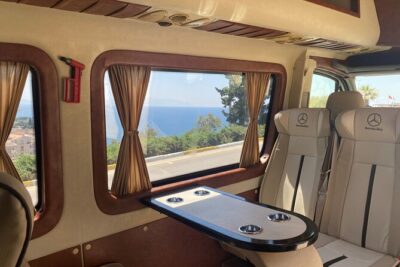
NO HIDDEN FEES : Private Ephesus – Miletus – Didyma
Read our review →
Kusadasi Shore Excursion: Private Full-Day Tour to Ephesus, Didyma and Miletus
Read our review →
Private Full-Day Ephesus Tour with Miletus and Didyma for Cruise Guests
Read our review →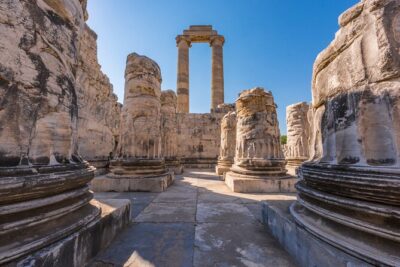
Priene Miletos Didyma (PMD) Tour From Kusadasi Port / Hotels
Read our review →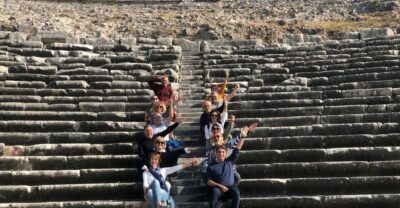
Private Ephesus Miletus Dydima Tour from Port Kusadasi
Read our review →Browse the lists this tour appears in